

 English
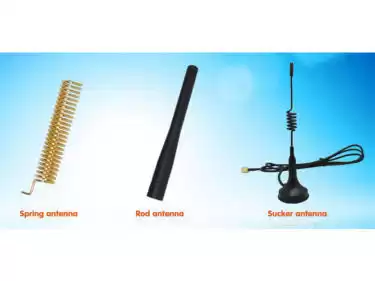
Which antenna is better for uart rf module?
Generally, the antennas used in conjunction with uart rf modules include spring antennas, rod antennas, and sucker antennas. So which type of antenna
Jan . 2026
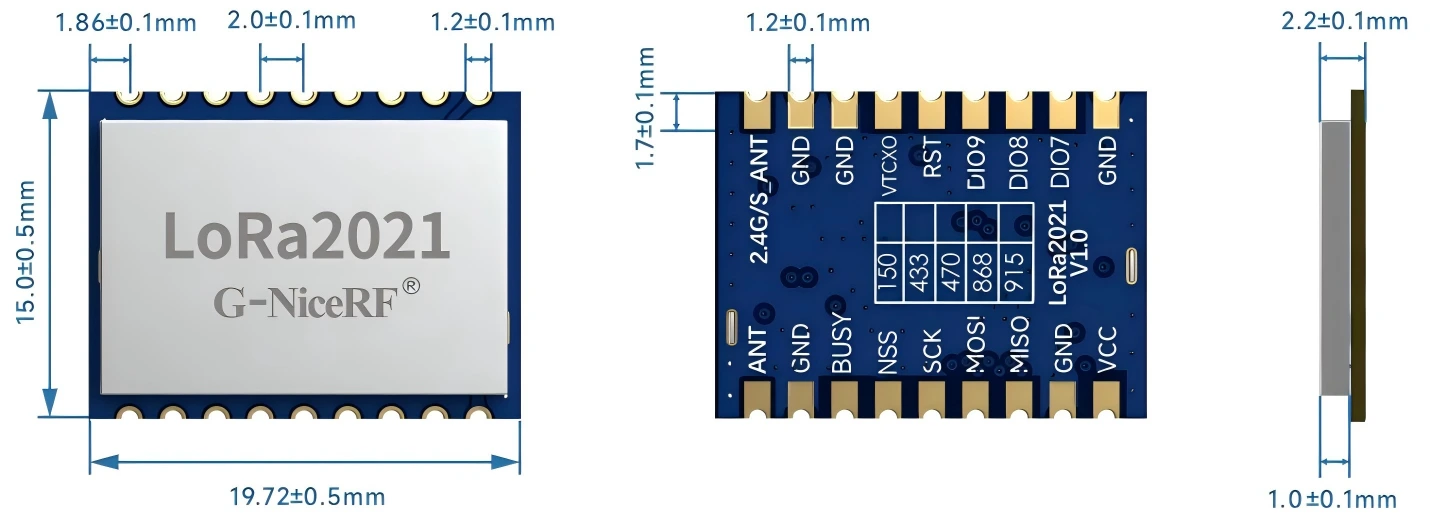
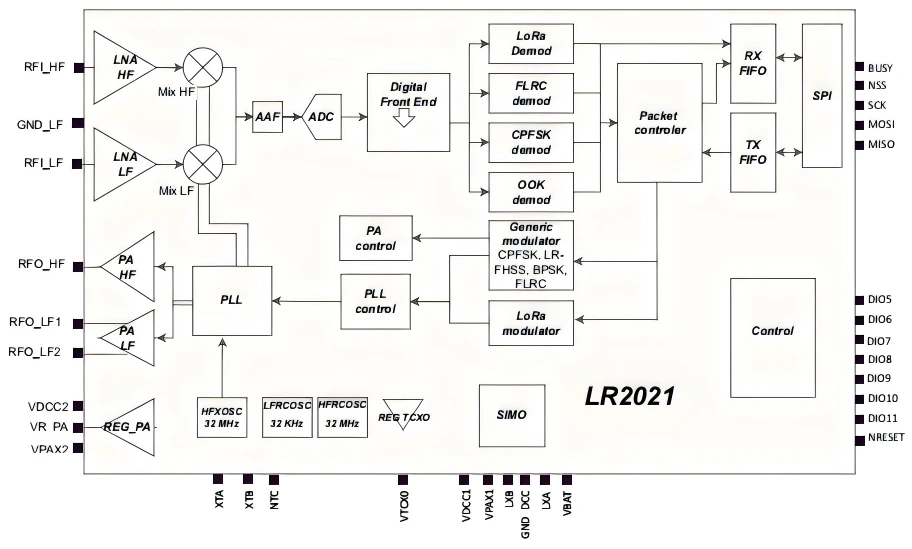
LoRa2021 is a wireless transceiver module developed by G-NiceRF based on the latest generation LoRa chip LR2021 of Semtech. It not only continues the advantages of LoRa long-range communication but also achieves a leap from "low-speed sensing" to "high-speed transmission".
The typical value of the sensitivity of LoRa2021 reaches -143 dBm (SF12/62.5 kHz). LR2021 adds support for FLRC in the Sub-GHz band, and the transmission rate of the module can reach up to 2.6 Mbps (up to 125 kbps in standard LoRa mode).
With higher bandwidth/throughput, it can support image transfer, voice-clip uploads, and larger-payload updates (actual performance depends on distance and link margin).
Furthermore, this module covers a wide range of frequency bands. It supports the common Sub-GHz (standard 433/470/868/915 MHz, customizable 150-960 MHz) and 2.4 GHz ISM bands. It also supports the 1.5-2.5 GHz high frequency band (including S-band satellite communication), achieving coverage from the ground to satellites.
This effectively solves communication problems in areas without public network coverage and eliminates the need to develop different hardware versions for different countries. The same product can adapt to different global markets through software configuration, which greatly reduces inventory pressure and research and development costs.
At the same time, while maintaining low power consumption with a sleep current of ≤ 2 µA, LoRa2021 integrates LR-FHSS frequency hopping spread spectrum technology to cope with environments with strong interference. It supports RTToF ranging and is fully compatible with mainstream IoT protocols such as LoRaWAN, BLE 5.0, and Wi-SUN.
To verify the actual performance of the chip, specifically the transmission distance of "FLRC High Speed Mode" and "Traditional LoRa Mode" in actual scenarios, we conducted a field test at Shenzhen OH Bay.
We started from the vicinity of the Ferris wheel at OH Bay and conducted the test across the sea surface of Qianhai Bay.
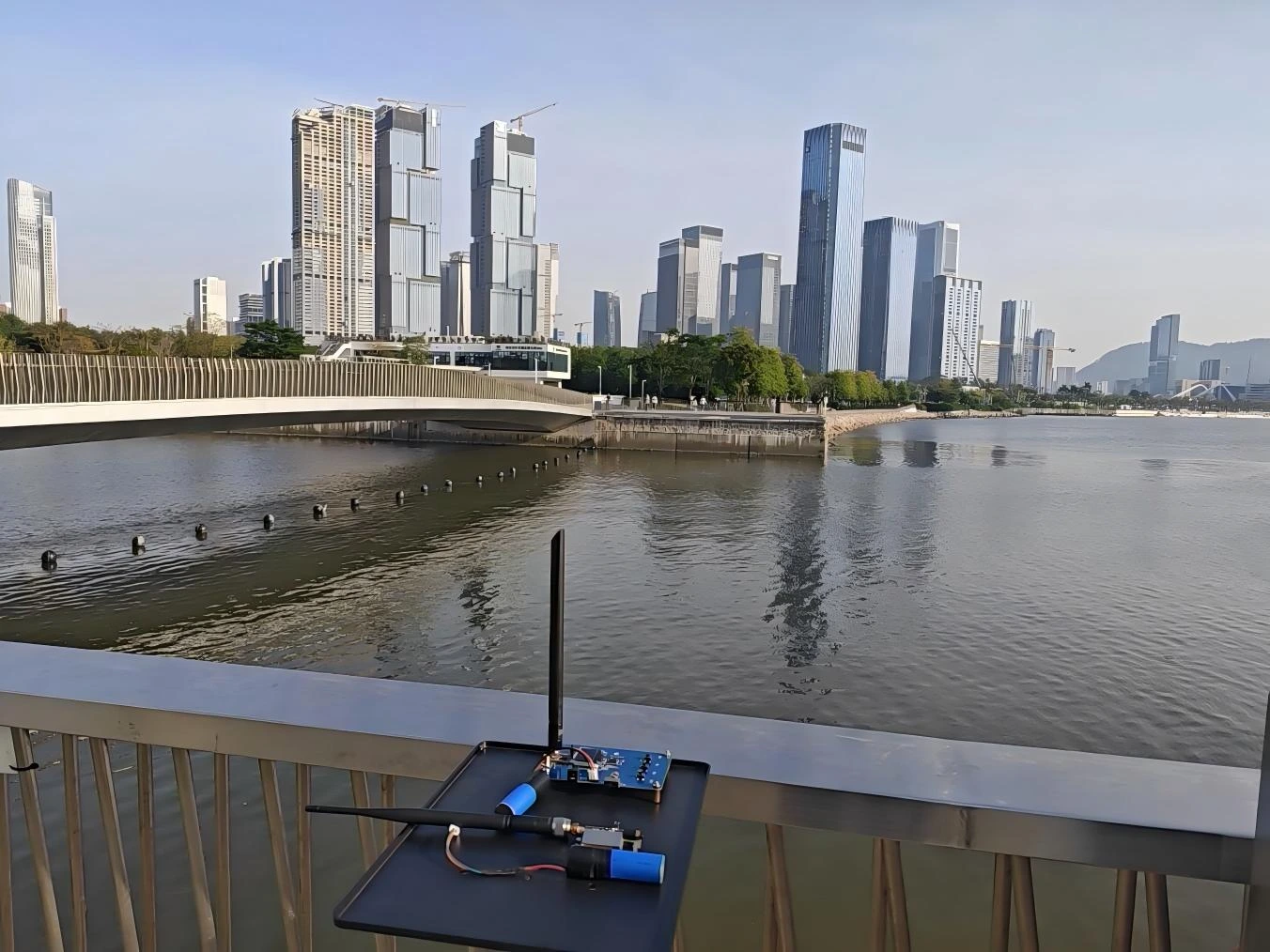
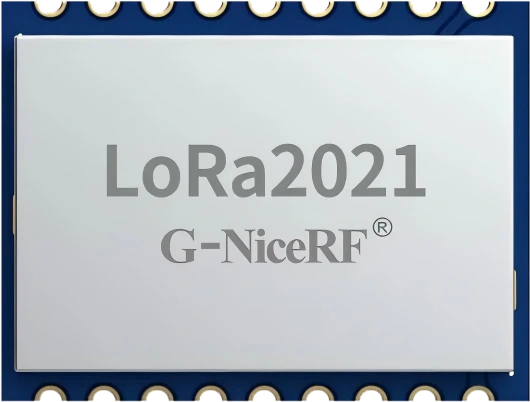
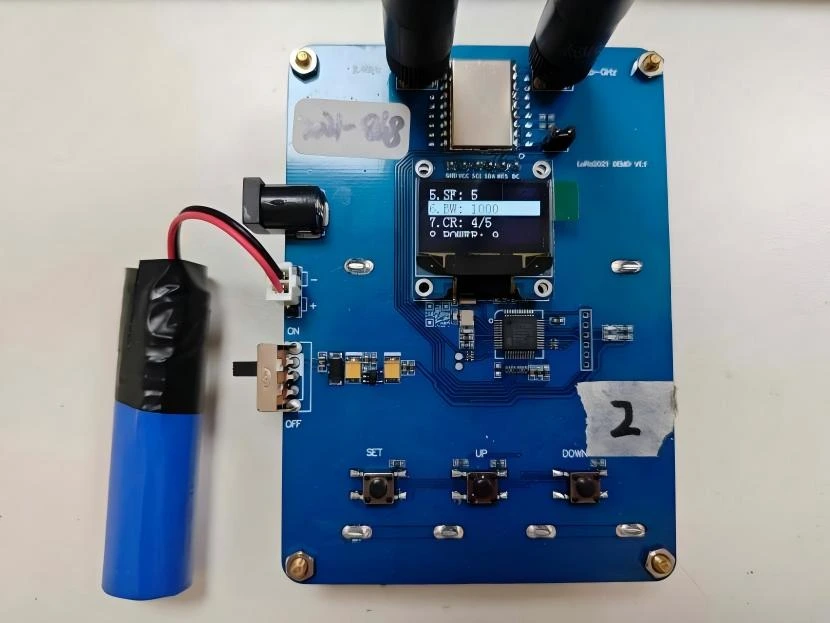
Core Module: LoRa2021 (Semtech LR2021 Chip)
Demo Board: LoRa2021 DEMO V1.0
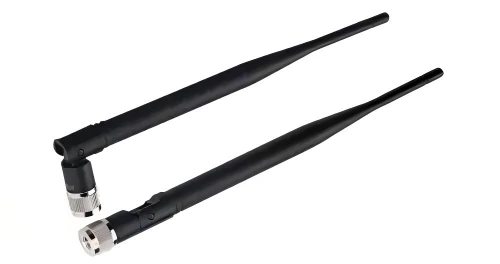
Antenna Configuration: SW868-ZD210 Folding Rod Antenna (VSWR ≤ 1.5)
* If you need to check the pin definitions of the module or the detailed performance parameter table, please refer to the Appendix section at the end of the text.
This test covered FLRC High Speed Mode and LoRa Long Range Mode, and we recorded the actual number of received packets at different distances in Sub-GHz and 2.4 GHz bands respectively.
Module Power: 21 dBm ± 1 dB (Sub-GHz) / 12 dBm (2.4 GHz)
Test Frequency: 860.5 MHz (Sub-GHz) / 2486.5 MHz (2.4 GHz)
Number of Packets Sent: 100 packets per group
Payload Length: 255 Bytes @ FLRC; 10 Bytes @ LoRa
(Note: The value represents the number of data packets actually received successfully, with a full score of 100. The test distance points for this time only cover up to 1.8 km due to site limitations. This does not represent the communication limit, and we will add data for distances greater than 1.8 km in the future.)
Work Mode | Rate | Key Parameters | 876m (Received) | 1.4km (Received) | 1.8km (Received) |
FLRC (Sub-G) | 2.6 Mbps | CR=1/2, SHAPE=BT 0.5 | 100 | 96 | 91 |
1.3 Mbps | 98 | 91 | 93 | ||
650 kbps | 100 | 99 | 95 | ||
260 kbps | 100 | 99 | 95 | ||
FLRC (2.4 GHz) | 2.6 Mbps | CR=3/4, SHAPE=BT 0.5 | 93 | 78 | 52 |
1.3 Mbps | 100 | 75 | 72 | ||
650 kbps | 100 | 81 | 79 | ||
260 kbps | 100 | 89 | 80 | ||
LoRa (Sub-G) | 125 kbps | SF=5, BW=1000 | 100 | 97 | 99 |
62.5 kbps | SF=5, BW=500 | 100 | 100 | 100 | |
1.7 kbps | SF=9, BW=125 | 100 | 100 | 100 | |
0.98 kbps | SF=10, BW=125 | 100 | 100 | 100 | |
LoRa (2.4 GHz) | 101.5 kbps | SF=5, BW=812 | 100 | 94 | 96 |
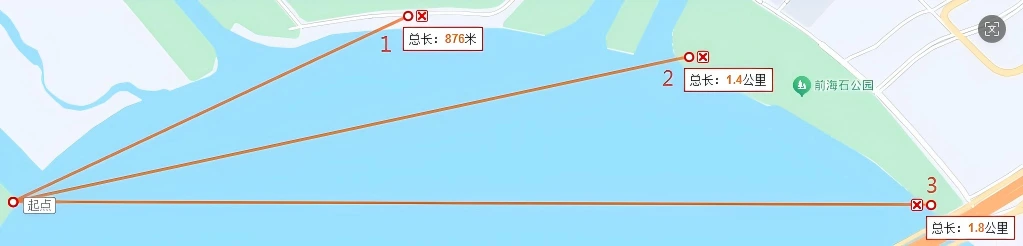
In the actual test at the three distance points of 876 m / 1.4 km / 1.8 km, with 100 packets per point, the link margin of the Sub-GHz band was significantly larger.
FLRC could still achieve Mbps-level rates at 1.8 km with PDR ≥ 91% (Payload 255B). LoRa also performed very stably under these parameters, with multiple settings reaching PDR = 100% at 1.8 km (Payload 10B).
In comparison, the 2.4 GHz band was more prone to packet loss at long-distance high-speed settings. FLRC 2.6 Mbps dropped to PDR = 52% at 1.8 km (we will explain the relevant reasons later), but the PDR improved significantly after reducing the speed.
However, LoRa at 2.4 GHz still reached PDR = 96% at 1.8 km, making it suitable for medium to long-range applications that require global common frequency bands.
Note: The Payload length of FLRC and LoRa is different (255B vs 10B), so the "reception rate" can be used for horizontal comparison within each mode, but we do not recommend comparing the PDR of the two modes directly as absolute superiority or inferiority under equal conditions.
Key Results (PDR)
2.6 Mbps: 876 m/1.4 km/1.8 km = 100% / 96% / 91% (PER=9% @1.8 km)
1.3 Mbps: 98% / 91% / 93%
650 kbps: 100% / 99% / 95%
260 kbps: 100% / 99% / 95%
Within 1.4 km, 2.6 Mbps still maintained PDR = 96%, showing that the link still possesses usability under "high speed and large packet" conditions. Even when extended to 1.8 km, the highest rate of 2.6 Mbps still had PDR = 91%; while the 260–650 kbps settings could stabilize at PDR = 95%, which is more suitable for continuous transmission scenarios that are more sensitive to stability.
As for the situation where individual distance points show "higher values at further distances" (such as 1.3 Mbps being higher at 1.8 km than at 1.4 km), this is mainly caused by the on-site environment (interference/multipath/occlusion) and belongs to normal fluctuation.
Suggestion for Selection
If you need "as fast as possible, accepting a small amount of retransmission", prioritize 2.6 or 1.3 Mbps. If you need "significantly more stable but still much faster than LoRa", then prioritize the 650 or 260 kbps settings (PDR ≈ 95% @1.8 km).
Key Results (PDR)
2.6 Mbps: 93% / 78% / 52%
1.3 Mbps: 100% / 75% / 72%
650 kbps: 100% / 81% / 79%
260 kbps: 100% / 89% / 80%
At 1.8 km, 2.6 Mbps dropped to PDR = 52%, indicating that this setting was close to the link boundary. Compared to Sub-GHz, 2.4 GHz is more prone to signal loss.
This mainly comes from the cumulative loss of the "Link Budget": the transmission power is 9 dB less (12 dBm vs 21 dBm), and the frequency term in the free space path loss alone adds about 9.2 dB (20log(2486/860.5) ≈ 9.2 dB).
The combination of the two produced a budget difference of about 18 dB. When superimposed with the environmental interference of the 2.4 GHz ISM band, packet loss is more likely to occur at long distances and high speeds.
Suggestion for Selection
If the target distance is close to the kilometer level and you pursue usability, we suggest reducing the speed of FLRC 2.4 GHz to 650/260 kbps (at this time 1.8 km PDR ≈ 79–80%). If you must maintain higher reliability, then you need to consider improving antenna conditions/link margin (such as external PA, antenna gain, higher installation, optimizing directionality) or switching directly to LoRa settings.
Key Results (PDR)
125 kbps (SF5/BW1000): 100% / 97% / 99%
62.5 kbps (SF5/BW500): 100% / 100% / 100%
1.7 kbps (SF9/BW125): 100% / 100% / 100%
0.98 kbps (SF10/BW125): 100% / 100% / 100%
Even at the high-speed setting of LoRa (125 kbps), it still reached PDR = 99% at 1.8 km, showing that the interference resistance and coverage capability of the link are very strong.
At lower rate settings (≤62.5 kbps), all three distances achieved 100/100 full reception, showing a clear advantage in long-distance stability, which is very suitable for telemetry, meter reading, or alarm applications that are "low speed but must be stable".
Key Results (PDR)
101.5 kbps (SF5/BW812): 876 m/1.4 km/1.8 km = 100% / 94% / 96% (PER=4% @1.8 km)
Maintaining PDR = 96% at 1.8 km under the constraints of 2.4 GHz shows that LoRa 2.4 GHz can completely serve as a medium to long-range communication solution under the demand of "unified frequency band/global compatibility".
Image/Audio/OTA (Distance < 1.8 km): The first choice is FLRC 2.6 Mbps. The actual test shows a reception rate of over 90% within 1.8 km, and it is fully usable within 1.4 km, which is a scenario that traditional LoRa modules cannot achieve.
Complex Industrial/High Frequency Acquisition (Distance 1~2 km): We recommend FLRC 650 kbps or LoRa 125 kbps. Both maintained excellent connectivity rates (>95%) at 1.8 km, and the rate is sufficient to cope with dense sensor data.
Extreme Environment/Ultra Long Range (Distance > 2 km): We recommend choosing LoRa 62.5 kbps or lower. The actual test showed 100% reception rate throughout the route, demonstrating excellent reliability.
SW868-ZD210 is a vertically polarized antenna. In actual deployment, please ensure to keep the antenna standing vertically and away from metal obstructions.
Remember not to place the antenna horizontally or stick it on a metal shell for the sake of aesthetics, as this will cause polarization mismatch and significantly reduce the signal.
The wireless environment is full of variables, and signal fluctuations are inevitable. We suggest adding an ACK retransmission mechanism in the software application layer.
Especially when working at the critical point of distance using high-speed mode, the retransmission mechanism can effectively repair sporadic packet loss and ensure user experience.
LoRa2021 can support LoRaWAN and Sigfox in the Sub-GHz band, and is also compatible with Bluetooth® LE 5.0, IEEE 802.15.4 (Zigbee/Thread), and Z-Wave in the 2.4 GHz band. Using only one set of hardware solutions can smoothly adapt to the market needs of different regions and different ecosystems.
In the future, it is also expected to achieve direct configuration via mobile phone Bluetooth. This will make on-site deployment and maintenance much simpler, and engineers will no longer have to rely on extra dedicated tools or complex network entry processes. For products that emphasize BOM efficiency and hope for "one set of hardware for the whole world", this cross-ecosystem compatibility capability is indeed a plus.
In addition to the "hard indicators" of frequency bands and protocols, LoRa2021 also has some more underlying features that have a direct impact on experience, such as:
Integrated SIMO High-Efficiency Power Architecture: The chip has a built-in SIMO (Single-Inductor Multiple-Output) DC-DC converter. Compared with the traditional LDO power supply method, it can more effectively reduce the system working current. For example, the Sub-GHz receiving current can be less than 6 mA, which usually means longer battery life and leaves a larger margin for the power budget of the whole machine in practical applications.
Massive Connection Capability of LR-FHSS: In addition to interference resistance, LR-FHSS technology also greatly improves network capacity. It allows a large number of nodes to transmit concurrently on the same channel without serious signal conflicts, which is very suitable for dense deployment scenarios of millions of nodes (such as water, electricity, and gas meters).
Enhanced CAD (Channel Activity Detection): Compared with traditional chips, it can listen to the channel quickly with lower power consumption. This is very important for battery-powered "receiver" devices and can significantly extend standby life.
Multi-Spreading Factor Simultaneous Reception: The module can automatically demodulate signals of different spreading factors (SF). This means that during point-to-point networking, the receiving end does not need to "negotiate" the rate in advance, greatly simplifying the protocol design difficulty of self-organizing networks.
Higher Frequency Offset Tolerance: This chip can adapt to harsh RF environments. Even when the crystal frequency drifts due to outdoor temperature differences, or when there is complex interference, it can still lock the signal stably, while supporting the use of low-cost crystals to reduce BOM costs.
Addressing the lack of completeness in materials and code often encountered by developers at the implementation layer, as well as the trouble of antenna matching in RF development, G-NiceRF provides a "one-stop" solution.
To ensure the complete implementation of the solution, G-NiceRF not only provides core modules but also provides supporting enhanced products including smart antennas, as well as ODM/OEM customization.
A: We do not recommend this.
Hardware Architecture Reason: The LoRa2021 module physically brings out two independent RF interfaces, Pin 9 (Sub-GHz) and Pin 10 (2.4 GHz / S Band), on the hardware. The physical paths are separate.
Physical Matching Reason: The antenna size must match the wavelength. Forcibly using a 2.4 GHz antenna to transmit Sub-GHz signals will cause serious impedance mismatch. Most of the energy will be lost on the circuit board, and the communication distance will be significantly reduced.
Suggestion: Be sure to design dual antennas (Sub-G + 2.4 GHz). If space is limited and sharing is necessary, you need to design a complex combiner circuit and use a special wideband antenna. This is usually more expensive and harder to debug than the dual-antenna solution.
A: No.
The sleep current of LoRa2021 is only about 2 µA, which is on par with mainstream low-power chips.
More importantly, thanks to the built-in SIMO DC-DC converter and the high-speed characteristics of FLRC, when sending the same amount of data, the RF turn-on time is shorter (Time-on-Air is reduced) and the power conversion efficiency is higher, so the average power consumption of the system is actually lower.
A: The S-band (1.9-2.2 GHz) is mainly used to connect to satellite IoT networks such as EchoStar.
Note: Using this function requires the equipment to be in an outdoor open environment (able to see the sky), and you need to purchase the corresponding network service package from the satellite operator.
A: Its accuracy belongs to the meter level. This is certainly not comparable to the centimeter-level of UWB, but it wins in high cost-performance ratio.
For asset tracking scenarios that do not need precise positioning but only need to determine "which area the cargo is in" or "roughly how far away it is from me", it is a practical choice without extra hardware costs.
A: You cannot just look at the price of a single chip when calculating accounts; you must look at the total cost of the system (BOM).
Simplified Peripherals and Design: The LR2021 chip itself integrates a high-efficiency SIMO DC-DC converter, saving the external power management chip; at the same time, its single chip supports multi-band (Sub-GHz/2.4 GHz) and multi-protocol, which can replace traditional multi-chip solutions, reducing PCB area and peripheral components.
Reliability Value-add: LoRa2021 has a built-in ESD electrostatic protection circuit, which saves the cost of external TVS protection tubes and further improves the reliability of the product in complex industrial environments.
Hidden Value: Single SKU design supports global deployment. You only need to manage one core material, which greatly reduces the risk of stockouts and the complexity of inventory management.
For convenient and quick reference, the pin definitions and core performance indicators of the LoRa2021 module are attached below.
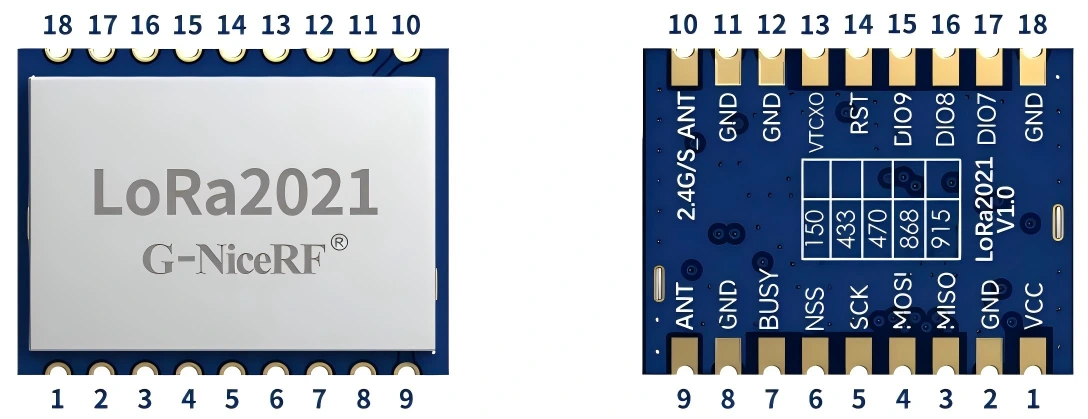
Pin Number | Pin Name | I/O | Description |
1 | VCC | - | Connect to power positive (1.8 V - 3.6 V) |
2, 8, 11, 12, 18 | GND | - | Connect to power negative |
3 | MISO | O | SPI Data Output |
4 | MOSI | I | SPI Data Input |
5 | SCK | I | SPI Clock Input |
6 | NSS | I | SPI Chip Select Input |
7 | BUSY | O | Status Indication (High level indicates busy) |
9 | ANT | - | Sub-GHz Band Antenna Interface (50 Ω) |
10 | 2.4G/S_ANT | - | 2.4 GHz and S Band Antenna Interface (50 Ω) |
13 | VTCXO | O | External TCXO Power Output |
14 | RST | I | Reset Trigger Input |
15, 16, 17 | DIO9, DIO8, DIO7 | I/O | Multi-purpose Digital Interface (Configurable Interrupt/GPIO) |
Parameter | Test Condition / Note | Typical Value | Unit |
Module Size | 19.72 * 15.0 * 2.2 | - | mm |
Operating Voltage | Recommended 3.3 V | 1.8 ~ 3.6 | V |
Operating Temperature | Industrial Level | -40 ~ +85 | ℃ |
Transmit Current | @433 MHz (22 dBm) | < 120 | mA |
@2.4 GHz (12 dBm) | < 35 | mA | |
Receive Current | @433 MHz / @2.4 GHz | < 6 / < 7 | mA |
Sleep Current | Shutdown Mode | < 2 | µA |
Receive Sensitivity | Sub-GHz (SF=12, BW=62.5 K) | -143 | dBm |
2.4 GHz (SF=12, BW=203 K) | -137 | dBm | |
Frequency Error | Crystal Accuracy | ±10 | ppm |
TCXO | 0.5 | ppm |
 +86-755-23080616
 sales@nicerf.com
Website: https://www.nicerf.com/
Address: 309-315, 3/F, Bldg A, Hongdu business building, Zone 43, Baoan Dist, Shenzhen, China
Privacy Policy
· Privacy Policy
There is currently no content available
Email:sales@nicerf.com
Tel:+86-755-23080616